
www.usa-automation.net
20
'26
Written on Modified on
Fanless Edge AI Rack System Architecture
Neousys Technology and distributor Acceed provide the GT-92 fanless GPU computer to solve thermal and contamination challenges in industrial machine vision.
acceed.com
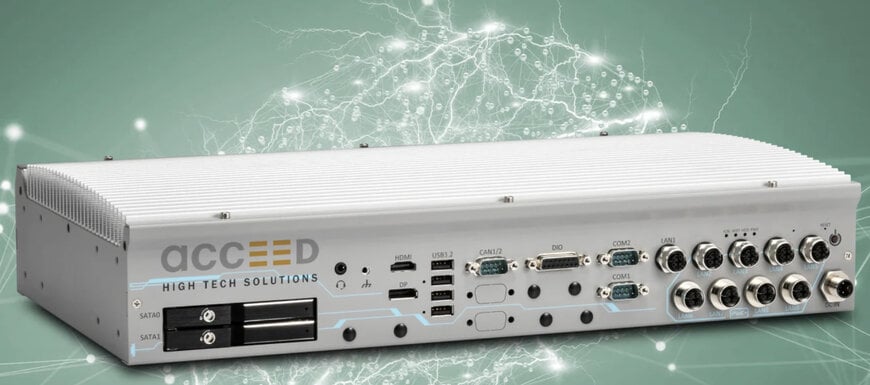
Deploying real-time artificial intelligence for optical quality control, robotic guidance, and autonomous mobile machines requires substantial local computing performance to avoid the latency and bandwidth costs of cloud architectures. To address the failure risks of active cooling in dusty, high-vibration environments, hardware distributor Acceed supplies the Neousys GT-92 (configured as the GT-92GC), a 19-inch rack-mountable edge AI system that integrates discrete GPU acceleration into a completely fanless chassis.
Thermal Management Challenges in Industrial Edge Computing
Processing high-resolution video streams and sensor data fusion directly at the point of generation places conflicting demands on industrial computer hardware. Real-time neural network inference requires central and graphics processing units with high thermal design power (TDP), which traditionally rely on forced-air cooling. However, in manufacturing plants, logistics hubs, and mobile machinery, cooling fans draw airborne dust, conductive particles, and moisture into the enclosure. Furthermore, mechanical fan bearings are susceptible to wear under continuous vibration, making fan failures one of the primary causes of unplanned hardware downtime in harsh industrial environments.
When edge computers must be installed inside standard 19-inch control cabinets or mounted on autonomous vehicles with restricted airflow, engineering teams face a trade-off between computational throughput and operational reliability. Eliminating moving parts through passive thermal dissipation prevents particulate ingress and mechanical wear, extending system service life and lowering the total cost of ownership (TCO) during continuous 24/7 operation.
Passive Cooling Architecture and Processing Performance
The Neousys GT-92 resolves the thermal bottleneck of passive GPU computing through an integrated heat pipe and extruded aluminum cooling fin architecture. Rather than relying on internal airflow, thermal energy from the processor and graphics card is conducted directly to the external heatsink surfaces. This thermal design enables the system to maintain both the CPU and the GPU within their specified thermal envelopes even under simultaneous maximum computational load.
Built on the Intel LGA1700 socket platform, the GT-92GC supports 12th, 13th, and 14th generation Intel Core processors configured for either 35 W or 65 W TDP. For parallel computing and deep learning inference, the system incorporates an Nvidia RTX 2000 ADA graphics card operating within a 70 W power envelope without active fans. When equipped with a 35 W TDP processor, the passive thermal management system supports continuous operation across an ambient temperature range from -25 °C to +55 °C. To handle large datasets and complex AI models in memory, the motherboard accommodates up to 64 GB of DDR5 RAM.
Multi-Camera Machine Vision and Industrial Interface Integration
A core requirement in automated optical inspection, robotic bin picking, and autonomous vehicle navigation is the synchronized ingestion of multiple high-bandwidth camera streams. The GT-92 addresses this by integrating high-density camera interfaces directly into the chassis, eliminating the need for external network switches or separate power injectors.
The system provides eight Gigabit Ethernet (GbE) ports equipped with Power over Ethernet Plus (PoE+) compliant with the IEEE 802.3at standard. When supplied with a 24 V input voltage, these ports deliver a combined power budget of up to 100 W to connected GigE Vision cameras over single cables. These are supplemented by one additional standard GbE port for network uplinks and four USB 3.2 Gen 2 ports capable of 10 Gbps data transfer rates for USB3 Vision cameras. This interface architecture allows up to twelve cameras—eight via Gigabit Ethernet and four via USB—to operate simultaneously on a single controller. For integration into broader industrial control and vehicle networks, the unit offers optional serial interfaces, CAN bus ports, and digital I/O (DIO) channels.
High-Speed Data Storage and Modular System Expansion
Continuous multi-camera data acquisition and local AI model execution require high storage write speeds and data redundancy. The GT-92 integrates an M.2 socket supporting NVMe solid-state drives (SSDs), achieving data transfer rates of approximately 7 GB/s to prevent bottlenecks during high-frame-rate image logging. For high-capacity local archiving or redundant data protection in RAID configurations, the chassis includes two drive bays for 2.5-inch SATA storage media.
To adapt to field communication requirements in mobile or remote deployments, the controller features two internal Mini PCI Express (mPCIe) slots paired with SIM card sockets. Engineers can populate these slots with cellular communication modules, Wi-Fi cards, or specialized industrial I/O expansion modules. Acceed provides the Neousys GT-92 in customer-specific hardware configurations, supplying production quantities alongside tailored accessories such as industrial power supplies and interface connection adapters.
Additional Context:
This section details technical specifications and competitive benchmarking not included in the original product announcement.
According to official technical documentation from Neousys Technology, the GT-92GC occupies a 2U, 19-inch rack-mount or wall-mount form factor measuring 440 mm in width, 250 mm in depth, and 88 mm in height (excluding mounting brackets), with a weight of 7.7 kg. While the original announcement notes configurations up to 64 GB of DDR5 memory, the underlying Intel R680E chipset platform and dual SODIMM slots officially support up to 128 GB of ECC or non-ECC DDR5-4800 SDRAM. To ensure connection integrity under severe mechanical stress, the eight PoE+ ports and the standard GbE port utilize ruggedized M12 X-coded connectors rather than standard RJ45 jacks, while the 8 V to 48 V wide-range DC power input is delivered via an M12 L-coded connector. The system is certified for shock and vibration resistance in accordance with railway standard EN 50155 and IEC 61373 (Category I, Class B, body-mounted), as well as electromagnetic compatibility under EN 50121, EN 55032, and EN 55035.
In the embedded NVIDIA RTX 2000 Ada Generation architecture utilized by the system, the GPU integrates 3,072 CUDA cores, 96 fourth-generation Tensor cores, and 24 third-generation RT cores paired with 8 GB of GDDR6 memory featuring error-correcting code (ECC) support, delivering up to 12.99 TFLOPS of peak FP32 performance. When configured with a higher-wattage 65 W TDP processor instead of a 35 W CPU, the specified passive operating temperature range adjusts to -25 °C to +35 °C without PoE load.
Within the industrial edge AI hardware sector, the GT-92GC occupies a distinct architectural tier between compact ARM-based systems-on-module and actively cooled 19-inch rackmount industrial PCs. Comparable fanless edge AI systems frequently rely on the NVIDIA Jetson AGX Orin industrial module, which operates within a 15 W to 75 W power envelope and provides up to 275 INT8 TOPS, or utilize desktop-derived box PCs such as the Neousys Nuvo-9000 or Vecow ECX-3000 series. While standard 2U 19-inch rackmount industrial computers from manufacturers such as Advantech or Kontron support higher-wattage full-length PCIe graphics cards (often 150 W to 300 W TDP), those systems require high-airflow chassis fans and dust filter maintenance, restricting their operating temperature ceilings typically to +40 °C or +45 °C. By contrast, combining an x86 LGA1700 CPU with a 70 W embedded Ada Lovelace GPU in a sealed, M12-connected 2U enclosure allows the GT-92GC to run legacy x86 machine vision software alongside GPU-accelerated inference inside unventilated control cabinets and rolling stock environments.
Edited by Sucithra Mani, Induportals editor – adapted by AI.
www.acceed.com
