
www.usa-automation.net
22
'26
Written on Modified on
GPU-Accelerated Multiphysics & EDA Simulation Architecture
Synopsys expands GPU-accelerated electronic design automation and multiphysics solvers supporting NVIDIA CUDA-X libraries to accelerate semiconductor and autonomous systems engineering.
www.synopsys.com
Modern microelectronic design and multi-domain physical simulation face computational bottlenecks when scaling to sub-nanometer lithography nodes, multi-die 3D packaging, and real-time physical AI testing. Traditional central processing unit (CPU) cluster architectures struggle to process dense partial differential equations and volumetric optical models within acceptable design-cycle timeframes, forcing engineering teams into compromises between numerical precision and simulation speed.
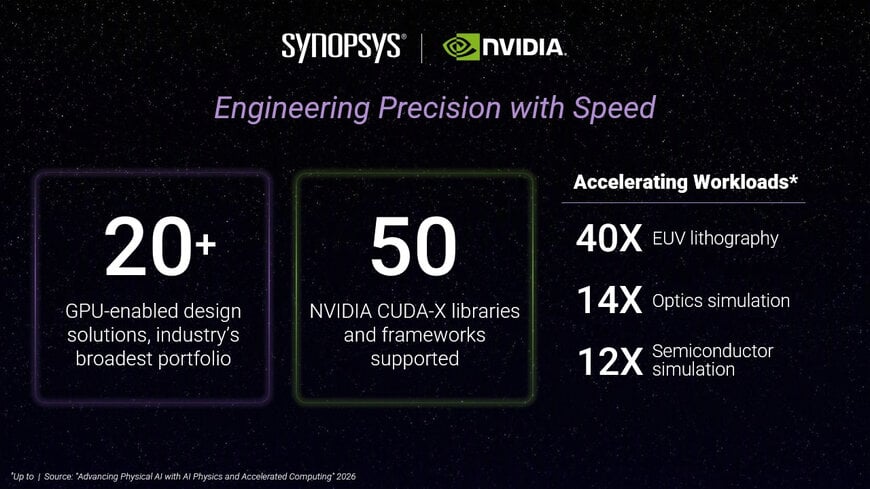
At NVIDIA GTC Berlin, Synopsys showcased an expanded portfolio of more than 20 GPU-enabled electronic design automation (EDA) and multiphysics simulation tools integrated with 50 NVIDIA CUDA-X libraries and frameworks. The engineering initiative focuses on porting compute-intensive TCAD (Technology Computer-Aided Design), finite-difference time-domain (FDTD) electro-optical solvers, optical ray tracing, and autonomous vehicle safety validation workflows directly to GPU-accelerated computing architectures.
Semiconductor Manufacturing and Device Physics Solvers
Physical scaling in advanced node semiconductors requires deep process emulation and device modeling. In TCAD workflows, calculating electric field distributions, carrier transport, and thermal runaway under extreme voltage gradients involves solving massive systems of sparse linear equations.
Infineon deployed Synopsys Sentaurus Device paired with the NVIDIA cuDSS (CUDA Direct Sparse Solver) library. By offloading sparse linear algebraic systems to GPU hardware, Infineon achieved a 12x reduction in simulation duration for 3D electrical breakdown analysis on next-generation power electronics.
In optical lithography modeling, advanced node scaling relies on modeling deep ultraviolet (DUV), extreme ultraviolet (EUV), and High-Numerical Aperture (High-NA) EUV wavefront interactions through mask structures and photoresists. European research institution Imec integrated Synopsys S-Litho computational lithography software into its process modeling flows. Utilizing NVIDIA CUDA-X accelerated libraries, Imec measured execution speedups up to 40x on its High-NA EUV benchmark workloads compared to conventional CPU environments.
Automotive Sensor Simulation and Traceable Functional Safety
Autonomous driving validation requires closed-loop verification where virtual environments project sensor stimuli directly into autonomous driving perception stacks.
Synopsys integrated its verification suite with the NVIDIA Halos SAFE safety assurance framework to build a verifiable safety lifecycle workflow. The architecture connects Ansys AVxcelerate real-time sensor simulation technologies—now part of the Synopsys portfolio following its acquisition of Ansys—to software-in-the-loop (SIL) and hardware-in-the-loop (HIL) test rigs. These raw synthetic camera, radar, and LiDAR feeds correlate with Ansys medini functional safety analysis tools. Medini links synthetic edge-case scenarios directly to hazard analysis and risk assessment (HARA) models, establishing traceable safety evidence aligned with automotive functional safety standards.
For optical exterior lighting simulation, Synopsys collaborated with T-Systems using an automotive lighting workload approved by FORVIA HELLA within T-Systems' sovereign Industrial AI Cloud. Running Monte Carlo optical ray tracing via Ansys Speos on NVIDIA GPU nodes reduced the overall simulation run from more than 4.5 hours on CPU clusters to under 19 minutes.
Photonic Transceiver and High-Density Optical Interconnect Design
AI data center clusters demand optical interconnects to overcome copper channel loss, dispersion, and thermal dissipation limits. Designing integrated silicon photonics requires full-wave electromagnetic modeling via 3D finite-difference time-domain (FDTD) methods, which discretize Maxwell's curl equations over sub-wavelength spatial grids across thousands of time steps.
iPronics deployed Ansys Lumerical FDTD on NVIDIA H100 GPU clusters within Amazon Web Services (AWS) infrastructure. The GPU-accelerated electromagnetic solver delivered a 13x speedup compared to a 96-core CPU baseline. In a representative design case involving a 20-point parametric parameter sweep of an optical edge-coupler, execution time decreased from approximately nine days on CPUs to 18 hours.
Alcyon Photonics integrated Ansys Lumerical to model integrated silicon photonic transceivers, directional couplers, and wideband routing subsystems. High-throughput electromagnetic simulations enable Alcyon to execute rigorous Monte Carlo statistical yield analysis across semiconductor foundry process variations, alignment sensitivities, and spectral bandwidth tolerances prior to tape-out.
Additional Context:
This section details technical specifications and competitive benchmarking not included in the original product announcement.
The shift toward GPU-accelerated computing within EDA represents an architectural transition from distributed, memory-bandwidth-constrained CPU clusters toward massively parallel heterogeneous architectures. In classical EDA, direct sparse linear solvers (such as SuperLU or MUMPS) historically exhibited poor GPU parallelization efficiency due to irregular nonzero fill-in patterns, unstructured memory access, and branch divergence.
The introduction of NVIDIA cuDSS addresses this by implementing batched multifrontal Cholesky, LU, and LDLT factorizations optimized for GPU tensor and CUDA cores. In power semiconductor device TCAD (such as drift region avalanche breakdown calculations in silicon carbide and gallium nitride devices), solving the coupled Poisson and continuity drift-diffusion equations requires iterative Newton-Raphson solvers. Offloading the inner Jacobian linear system factorization to cuDSS provides the 12x wall-clock speedup noted by Infineon by sustaining high floating-point utilization across massive sparse matrices.
Across the competitive EDA landscape, tool developers deploy differing strategies to mitigate compute scaling limits:
Cadence Design Systems developed the Palladium Z2/Z3 hardware emulation platforms alongside the Cadence Millennium Enterprise Multiphysics Platform. The Millennium platform pairs custom GPU computing appliances with proprietary finite-volume computational fluid dynamics (CFD) and aerodynamic solvers, achieving up to 20x to 100x acceleration in mechanical and multiphysics modeling. Cadence also accelerates its Clarity 3D electrodynamic field solver across distributed cloud GPU clusters for electromagnetic parasitic extraction.
Siemens EDA utilizes GPU acceleration within specific verification nodes, notably its Calibre nmPlatform for optical proximity correction (OPC) and machine-learning-enhanced DRC (design rule checking), alongside the Questa verification platform. While Siemens emphasizes distributed multi-threading across high-core-count enterprise server CPUs with selective GPU offloading for mask synthesis, Synopsys has expanded GPU acceleration natively across TCAD matrix solvers, finite-difference time-domain photonics, and physical lighting simulation pipelines.
Edited by Natania Lyngdoh, Induportals editor, with AI assistance.
www.synopsys.com
